| Vendor | Panel | Method | Turnaround | Notes |
|---|---|---|---|---|
| PreventionGenetics | Hereditary MDS / AML Panel (12 genes) | NGS with CNV (exome or genome platform) | 2-3 weeks (6-12 days STAT) | Accepts blood, DNA, buccal, saliva, tissue (exome platform); now an Exact Sciences subsidiary |
| University of Chicago | Hereditary Hematologic Malignancies (UCM HHM) Panel | NGS + array CGH | Varies | Academic reference laboratory; CAP-certified, CLIA-licensed |
| Invitae | Hematology / hereditary cancer panels | NGS | Varies | Now operating under Labcorp following 2024 acquisition |
| AiLife Diagnostics | Genetic testing menu (GTR lab profile) | NGS (CAP/CLIA lab) | Varies | Texas-based lab (Pearland, TX); director Yaping Yang, PhD, FACMG; CLIA 45D2157396 |
2 HHM Clinics at VUMC
Hereditary Hematologic Malignancies clinic at Vanderbilt University Medical Center
2.1 Overview
This chapter documents the operational planning for the Hereditary Hematologic Malignancies (HHM) clinic at Vanderbilt University Medical Center (VUMC). It captures the people involved, germline testing options and panel content, genetic counseling resources, tissue-sourcing considerations, external clinics used as models, and the proposed clinic-establishment framework.
NoteWorking document
This is a living planning reference and is updated each quarter. Details (panel selection, scheduling, vendor choice) are being finalized and may change.
2.2 People Involved
- Kate Fedorov — Division of Hematology and Oncology, VUMC
- Ashwin Kishtagari — Division of Hematology and Oncology, VUMC
2.3 Genetic Counselors
- Meredith A. Gerhart — Genetic Counselor, VUMC
- Katie Lang — Genetic Counselor, VUMC
There is also a tele-medicine genetic counseling group that can be engaged for remote counseling capacity (Dr. DiNardo to send contact details).
TipBilling nuance
Genetic counselors typically conduct telehealth (TH) visits and cannot bill independently under current arrangements. The clinic model below pairs the counselor with a physician segment so the encounter is billable (see Section 2.7).
2.4 Panels for Testing
Several germline panels are under consideration. The PreventionGenetics Hereditary MDS/AML panel is a 12-gene next-generation sequencing test with copy number analysis, with a 2-3 week turnaround and flexibility in accepted specimen types.
2.4.1 PreventionGenetics MDS/AML panel - gene content
The panel covers 12 genes associated with hereditary myelodysplastic syndrome and acute myeloid leukemia predisposition.
[](0.0, 1.0)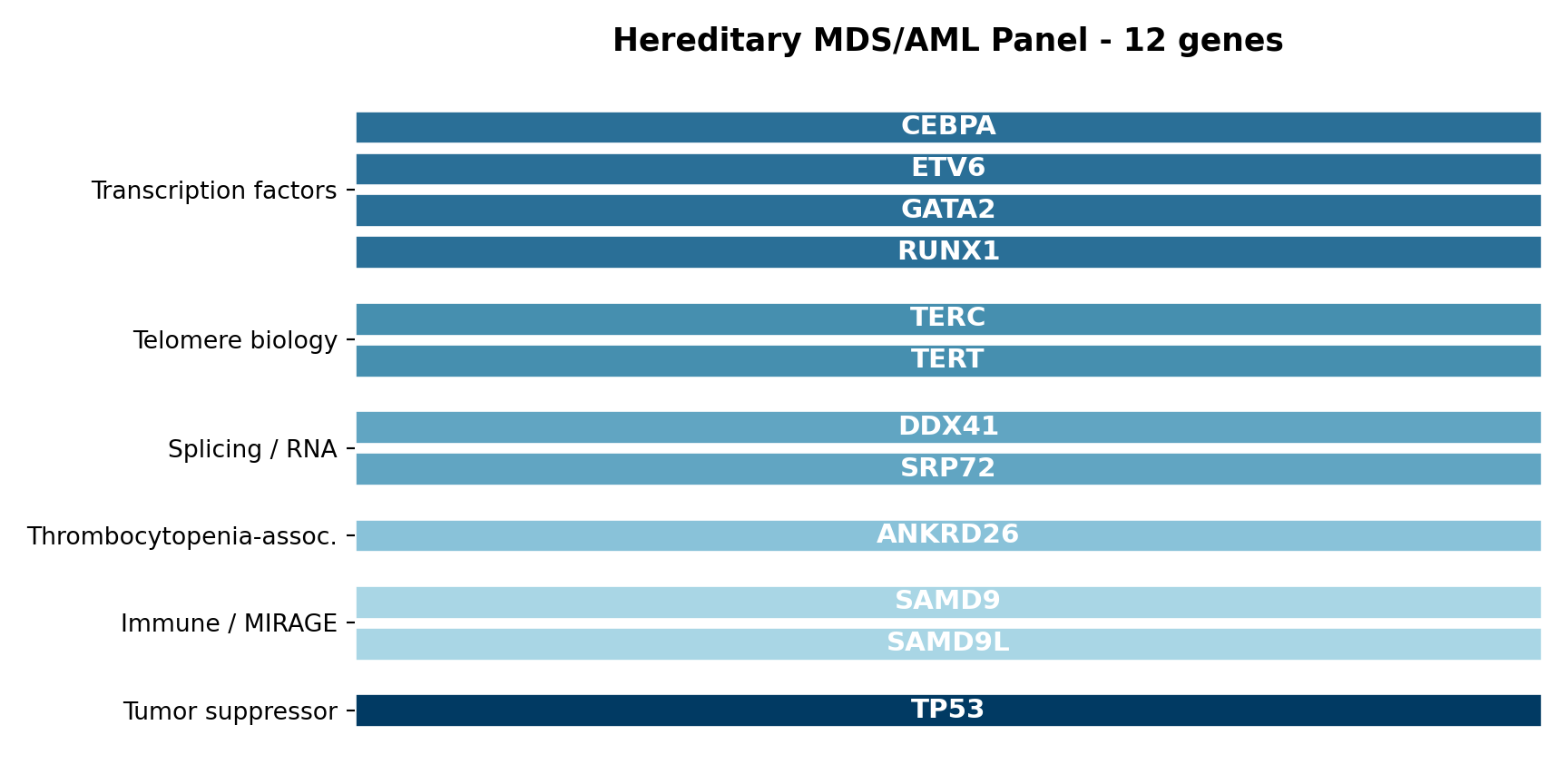
Full gene list: ANKRD26, CEBPA, DDX41, ETV6, GATA2, RUNX1, SAMD9, SAMD9L, SRP72, TERC, TERT, TP53.
NoteRUNX1-FPD
RUNX1 familial platelet disorder with predisposition to myeloid malignancy (RUNX1-FPD) is a key syndrome for this clinic and is captured on each candidate panel. Detailed surveillance and management are addressed in the disease-specific chapters.
2.5 Tissue for Germline Testing
Choosing the right specimen is essential for accurate germline results, particularly in patients with a hematologic malignancy where blood- or saliva-derived DNA may be contaminated by the malignant clone.
- Preferred: DNA extracted from cultured skin fibroblasts obtained via skin biopsy. This avoids hematopoietic contamination.
- Challenging specimens: hair follicles and nail clippings - the majority of vendors do not process these, which limits their practical use.
- Vendor note: per Dr. DiNardo, Invitae has historically been the strongest vendor for fibroblast-based germline testing (note the post-acquisition Labcorp transition when planning).
| Specimen | Preference | Consideration |
|---|---|---|
| Cultured skin fibroblasts | Preferred | Avoids hematopoietic clone contamination; requires skin biopsy + culture |
| Peripheral blood / saliva | Use with caution | Risk of contamination by malignant clone in hematologic malignancy |
| Hair follicles | Limited | Most vendors do not process |
| Nail clippings | Limited | Most vendors do not process |
2.6 Modeling Clinics Outside VUMC
To inform clinic design, we are drawing on established programs elsewhere.
- Courtney DiNardo (MD Anderson) - consulted August 11, 2025. Source of guidance on tele-genetic-counseling resources and fibroblast-based germline testing vendors.
2.7 Clinic Establishment Framework
The proposed operational model balances clinic capacity, counselor and physician time, and billing requirements.
- Cadence & slots: Tuesday afternoons, 4-5 one-hour slots, every 2 weeks.
- Visit structure: 45 minutes with the genetic counselor + 15 minutes with the physician, structured so the encounter is a billable visit (counselors generally perform telehealth visits and cannot bill independently).
(0.0, 60.0)(-0.6, 0.6)[]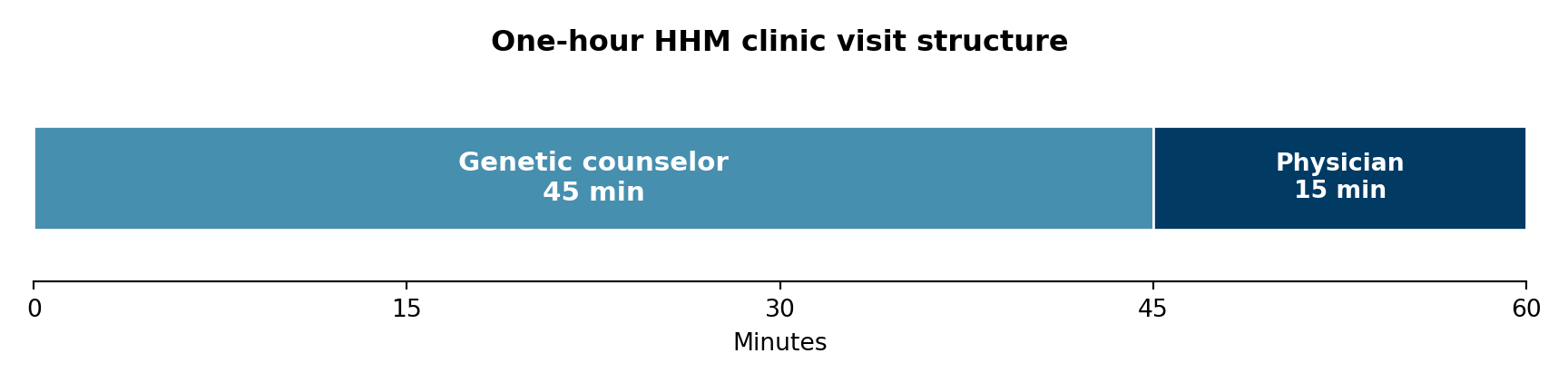
2.7.1 Capacity at a glance
At 4-5 slots per session and two sessions per month, the clinic can see roughly 9 patients per month (~108 per year) at full utilization, before accounting for cancellations or follow-up load.
2.8 Open Items
- Finalize panel/vendor selection (PreventionGenetics vs. University of Chicago vs. Invitae/Labcorp), weighing gene content, fibroblast handling, turnaround, and cost.
- Obtain tele-genetic-counseling group contact (pending from Dr. DiNardo).
- Confirm billing structure for the counselor + physician visit model.
- Define cascade (family) testing workflow for adult and pediatric relatives.
- Establish surveillance protocols for asymptomatic carriers.